You have the campaign. The creative has been approved. The media plan is sitting in a spreadsheet full of channels, audiences, formats, CPMs and projected impressions. Google, Meta, LinkedIn, programmatic networks, publishers, broadcasters and outdoor media owners are all perfectly happy to take your money.
But should they?
Because one of the easiest mistakes in marketing is to assume that buying more attention will solve a communications problem. It will not. If the audience is wrong, the proposition is weak, the creative does not resonate or the timing is poor, media spend does not repair the problem. It simply distributes it more efficiently.
That is the media buying trap. The conversation starts too late. Someone asks, “Where should we advertise?” when the more useful questions are still unanswered. Who precisely are we trying to reach? What do we need them to think, feel or do differently? Why are they not doing it already? Who influences that decision? What else is competing for their attention? When are they most receptive? What will make them stop, notice and care?
If you cannot answer those questions properly, you are not ready to buy media.
Are You Buying Reach, or Buying the Right Reach?
Big numbers are seductive. Ten million impressions sounds impressive in a board meeting. A national campaign feels substantial. A large share of voice looks reassuring on a dashboard. Yet none of those things tells you whether the people who matter actually noticed, understood or acted. There is a world of difference between being visible and being relevant.
This is why media buying should begin with audience intelligence rather than inventory. Who buys the product is not always the same person who uses it. Who signs the contract may not be the person who first encounters the brand. Who influences the purchase may sit completely outside the demographic assumptions traditionally associated with it. If you begin with an imagined customer rather than the real buying journey, everything that follows, from the creative to the targeting and ultimately the media spend, inherits that assumption.
The razor market offers a useful example. A product may ostensibly be designed and advertised for men, but that does not mean men are the only people making or influencing the purchase. Gillette has previously acknowledged that its customer data did not fully account for women buying its products for men in their lives, while wider NielsenIQ research estimates that women influence around 70–80% of consumer spending. More recent US research makes the crossover even clearer: in 2026, CivicScience found that 56% of women who buy razors purchase men’s versions at least occasionally, with almost one in five saying they always do. The person using the product, the person buying it and the person influencing the decision are not necessarily the same audience.
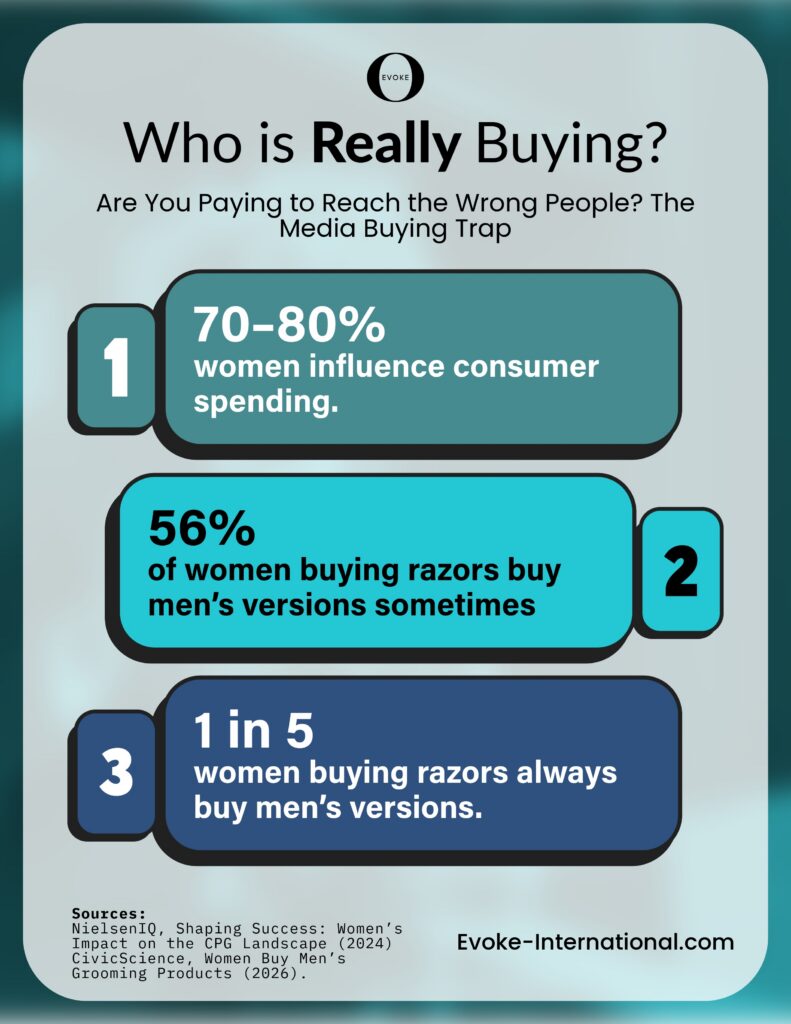
That distinction changes media strategy. If research tells you that a supposedly male product has a significant female purchaser or influencer audience, simply buying more media against men means paying to ignore part of the actual buying journey. The answer may involve different targeting, different media environments or even different creative. That does not necessarily mean making the product less masculine. It may mean ensuring that the communication also works for the person standing in the aisle, adding it to the household shop or making the purchasing decision.
The same principle becomes considerably more complicated in larger purchasing journeys. A major B2B contract may involve technical specialists, procurement teams, finance directors, end users and senior leadership, all influencing the decision for completely different reasons. A government programme may require public understanding while simultaneously depending upon political, institutional and community support. A consumer purchase may be made by one person, used by another and recommended by somebody else entirely. There is rarely one neat audience waiting to receive the campaign
The lesson is not that there is some clever demographic trick waiting to be discovered. It is that assumptions are expensive. If your understanding of the audience comes from who you imagine buys the product rather than evidence of who actually influences the decision, every pound, dollar or dirham spent afterwards inherits that mistake.
At Evoke, this is why we prefer to start before the media plan exists. We understand; audience, market, behaviours, motivations, barriers, cultural context and the wider communications environment’s. Sometimes that confirms what the organisation already believes. Sometimes it reveals an audience that was barely considered. Sometimes it shows that the audience is right but the message is wrong. Occasionally it exposes the uncomfortable answer that neither the creative nor the communications strategy is solving the real problem.
That matters because the cheapest media is not necessarily the best media, and the largest audience is certainly not always the most valuable one. The objective is not simply to reach more people. It is to waste less money reaching people who were never going to act.
What If the Media Is Fine, but the Content Is the Problem?
This is where media buying becomes awkward, because the answer is sometimes that you should not buy more media at all.
You can target the perfect audience on the perfect platform at precisely the right moment and still fail if what you put in front of them gives them no reason to care. A technically brilliant media strategy cannot rescue generic creative. In fact, sophisticated targeting can make weak creative more revealing because it removes one of the traditional excuses. If you know you reached the right people and nothing happened, the problem is somewhere else.
Content and media therefore cannot be separated as neatly as agency structures often suggest. The colour, image, headline, format, length, tone, placement and surrounding environment all change how communication is received. Something that works on a large outdoor screen may collapse inside a mobile feed. A thirty-second film can create emotion where a static advert cannot. Search advertising meets an audience already expressing intent, while social media may need to create that intent from nothing. LinkedIn, television, podcasts, print, influencers, programmatic display and physical outdoor spaces do not simply offer different sizes of audience; they create different psychological contexts for the message.
Then there is timing. People are not equally receptive throughout the day, week, year or economic cycle. There are buying seasons, commuting periods, cultural moments, news cycles and competitor campaigns. There are occasions when the price of media rises because everyone else is chasing the same audience and occasions when an organisation can achieve disproportionate visibility by moving slightly earlier, later or somewhere less obvious. The expensive slot is not automatically the valuable one.
This is particularly important in 2026 because media has become extraordinarily easy to buy. Automated platforms can optimise placements, generate variants, identify audiences and move budget in real time. Artificial intelligence has made campaign production faster and lowered the technical barrier to entry. That convenience is useful, but it creates another danger: confusing optimisation with strategy. A platform can become extremely efficient at achieving the objective you gave it. It cannot necessarily tell you whether you gave it the right objective in the first place.
If the instruction is “generate clicks”, it will find clicks. If the instruction is “maximise video views”, it will find viewers. If the campaign delivers enormous reach at an attractive CPM, the dashboard may glow reassuringly green. None of those things automatically means the organisation sold more, changed behaviour, improved reputation or influenced the people who matter.
Do You Know Why Your Media Worked?
This is where we believe media buying becomes strategic rather than transactional. The job does not end when the campaign goes live. That is when the useful information starts arriving.
Most organisations can tell you what happened. Impressions increased. Cost-per-click fell. One advert outperformed another. Traffic peaked on Thursday. Video completion improved. Those measures matter, but they are only the surface of the story. The more valuable question is why. Why did one audience respond while another ignored the campaign? Why did the same creative perform differently between markets? Why did engagement increase without conversion? Why did a cheaper placement produce more valuable customers than the premium inventory? Why did one message work brilliantly with an older audience but completely miss the younger group it was designed for? Why did performance suddenly change halfway through the campaign?
Those answers require research, analytics and interpretation rather than simply a media dashboard. They also require the freedom to change course. If the evidence tells us that the audience assumption was wrong, we change it. If the creative is not working, we change the creative. If an unexpected group is responding strongly, we investigate why. If expensive inventory is delivering little more than prestige, we question whether the money belongs somewhere else.
That is a very different relationship with media spend. Rather than treating the media plan as something approved, purchased and defended, it becomes a living system: research informs strategy, strategy informs creative, creative informs placement, performance creates new intelligence and that intelligence feeds back into the next decision.
It is also why Evoke’s approach spans strategic communications, audience research, creative development, digital performance and media planning rather than treating each as an isolated service. In the real world they affect one another constantly. An insight uncovered during audience research can transform the creative. The creative can reveal a previously unnoticed audience response. Media performance can challenge the original strategy. Good media buying should make the entire communications system smarter.
So, Should Evoke Buy Your Media?
Possibly. But that is not necessarily where we would start.
If you already know exactly who your audiences are, understand what motivates them, have tested the proposition, know which creative resonates, understand when and where those audiences are receptive, have a clear measurement framework and can connect media performance to genuine organisational outcomes, then buying the media itself is relatively straightforward. There are plenty of platforms, networks and agencies capable of doing it.
If, however, the conversation starts with “we have this much money, where should we spend it?”, we would probably ask you to hold onto it for a moment.
We would want to know what success actually looks like. We would want to interrogate the audience assumptions, look at the data, understand the competitive environment, challenge the proposition and consider whether the content being distributed is strong enough to earn the attention you are about to pay for. We would look at paid media alongside owned, earned, organic and direct channels rather than assuming every problem requires another advertising placement. We would ask where expensive peak periods genuinely matter and where moving away from the obvious buying window could produce greater value. Once the campaign begins, we would expect the evidence to change some of our thinking.
Because media buying should not be an exercise in spending the budget correctly. It should be an exercise in making the budget work harder.
Sometimes that means buying more. Sometimes it means buying somewhere different. Sometimes it means changing the creative before another penny is spent. Sometimes it means discovering that the audience you thought mattered most is not actually the audience driving the decision. And sometimes the smartest media recommendation is simply: not yet.
The platforms will always be ready to take your money. The more important question is whether you are ready to give it to them.
Do not buy more media. Buy less waste!